We are in late January 2021. Needless to say that the hopes are high after the strenous year of 2020.
In Denmark the government has prolonged the December lockdowns of retail stores, schools, hair salons, massage parlors etc – right at the height of christmas shopping.
The businesses which are able to survive can hope for the lockdown to end early February. Which is very doubtful.
Vaccines are arriving but it does not hide the fact that especially the first two quarters of 2021 will be a slow crawl towards the light.
As an economic response to the Corona pandemic the EU Commision has obligateded all member countries to chip in for a “solidaric” recovery fund of 750 billion Euro.
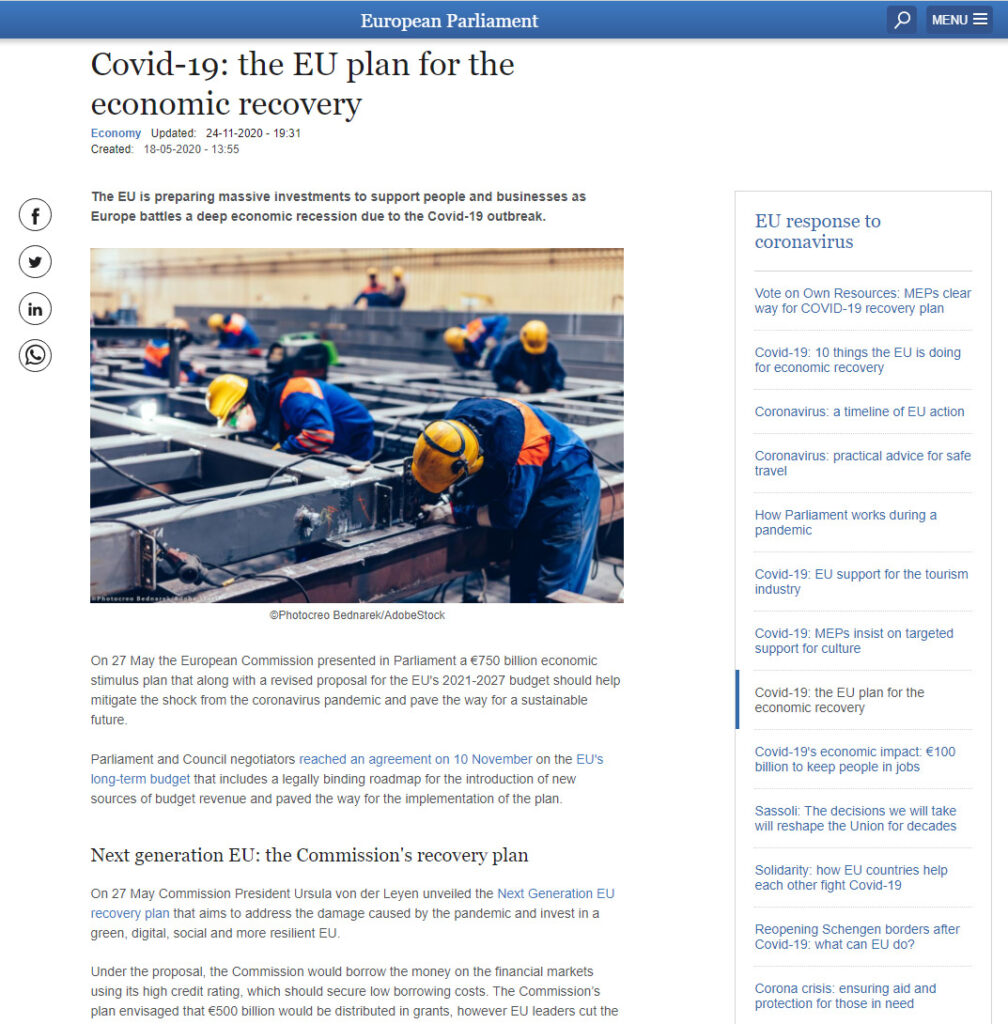
The overall purpose of the recovery fund can be divided into 4 areas:
- Create growth
- Create jobs
- Spur on “green” change
- Increase digitization
By critics this can be seen as either a form of bribe to certain member countries that are questioning their memebership of the EU, or, it can be seen as sincere help from rich member countries to struggling fellow members.
No matter what it will be a direct economic stimulance (quantitative easing) of the European economy.
However, 750 billion Euro will not be enough. More on that later.
The EU Recovery Fund was originally thought to be free money – a grant to struggling member countries with no strings attached.
However, a coalition of member countries (Holland, Sweden, Austria and Denmark) insisted that at least part of the fund be given as loans instead of free money.
As a result 390 billion is to be free money, the rest (360 billion Euro) is to be accessed as a loan, which the EU member countries can take on, if they choose to do so.
70% of the funds capital is to be distributed through 2021-2022. The last 30% will be handed out before the end of 2023.
Every member country takes on a burden of extra debt, the winning argument is the advantage of very low interest rates.
Here is how the EU imagines the process:
According to Startup Europe most of the funds will go to Southern Europe (Greece, Italy, Spain and Portugal) to prevent a potential recession of EU-historic proportions.
The national governments will be managing and distributing the funds to the worthy recipients.
Greece will primarily need funds for the small entrepreneurs who need capital in their early stages of development.
Italy, in turn, is plagued by slow digitization and the inability to grow small businesses.
While Italy is seeking to digitize its infrastructure Spain needs to educate its population in digital skills.
BUT (as stated earlier) at this point 750 billion Euro isn’t going to be enough.
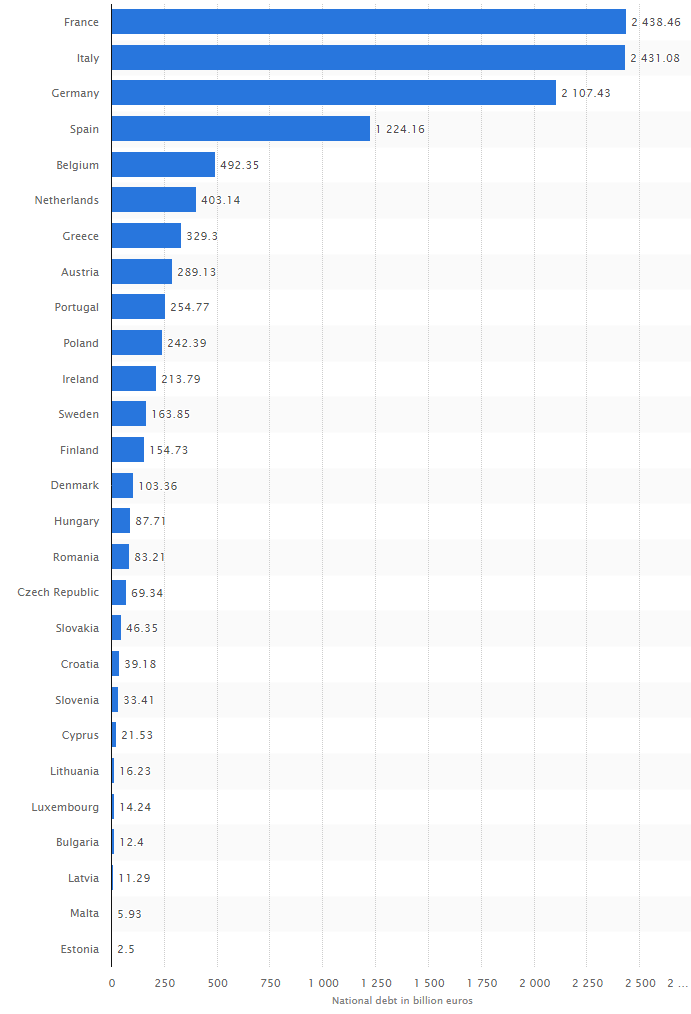
First, there’s the public debt. Even before the COVID-19 pandemic the national debt measured in Euro was already substantial in several major EU countries.
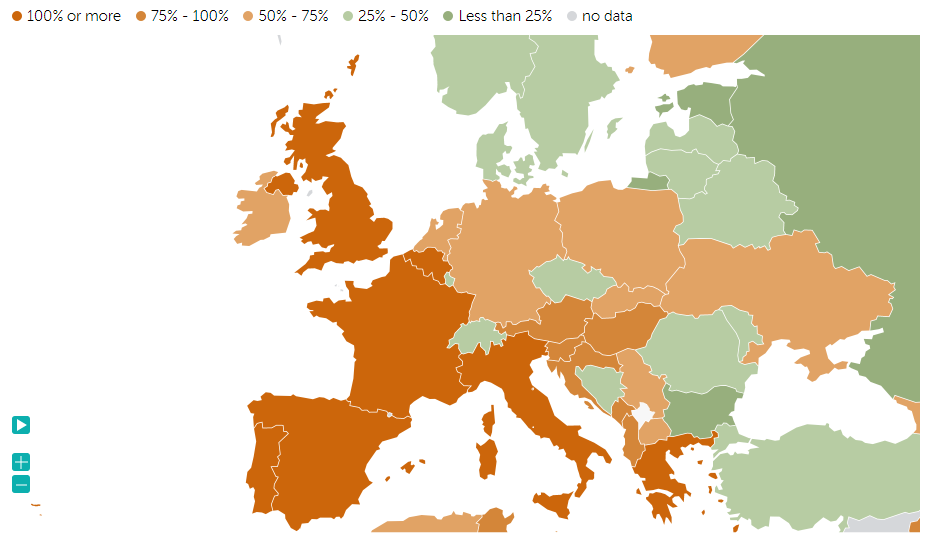
Looking at the Government debt to GDP ratios puts many major EU member countries in the red: United Kingdom, Belgium, France, Spain, Portugal, Italy and Greece.
Below (fig. 3) is the IMF debt prognosis for these EU countries:
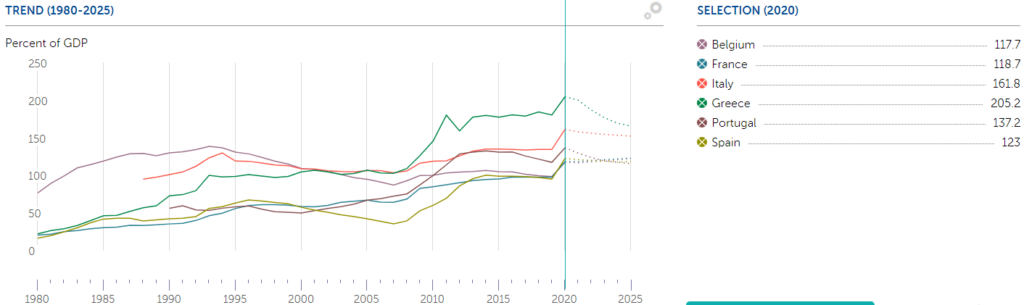
It is pretty safe to assume that the IMF debt prognosis onward from 2020 (fig. 3) of falling debt for Germany, Belgium, UK, France, Spain, Portugal, Italy and Greece will not hold. Debt will rise in 2021 in every part of the EU.
This creates another problem.
Studies have proven that there are limits to how high government debt can be before it begins to increasingly inhibit economic growth.
The debt-to-GDP percentage is an indicator of a nations ability to repay its debt. The ratio is calculated like this: (DEBT/ GDP * 100)
The public debt of France varies depending on which sources delivers the numbers.
According to Statista.com the government debt of France in 2020 was about 3,205,890,000,000 (trillion) dollars. The Gross Domestic Product (GDP) for France i 2020 was about 2,551,450,000,000 (trillion) dollars.
Let us make a calculation of the French debt-to-GDP:
(3,205,890,000,000 (trillion) dollars of debt divided by 2,551,450,000,000 (trillion) dollars of GDP) * 100 = 125,6 percent .
Even though the IMF listed debt-to-GDP is only 118 percent, this is not good.
Yet how much debt can a nation get away with, before it starts to hurt its outlook on growth?
Depending on which institution you ask the maximum debt-to GDP ratio vary for developed nations and developing nations
International Monetary Fund (IMF):
- Maximum debt-to-GDP ratio for developed countries is 60 percent.
- Maximum debt-to-GDP ratio for developing countries is 40 percent
The World Bank:
- Maximum debt-to-GDP ratio for developed countries is 64 percent
- Maximum debt-to-GDP ratio for developing countries is 40 percent.
The World Bank furthermore warns that countries with prologned periods of debt-to-GDP over 77 percent will experience significantly lower growth.
In all cases it goes that the higher the debt percentage to GDP the harder it will be to pay off the debt.
If the debt-to-GDP ratio exceeds 90 percent it inhibits growth notably for both developed and developing countries.
An important factor is the debt trajectory which signals whether government debt will be higher or lower in the years to come.
Secondly, there’s the private debt
Private businesses are hemmorrhaging liquidity and cashflow during the pandemic lockdowns. Many have taken on corporate debt due to the low interest rates.
If the private debt becomes too great it risks turning into public debt through defaulting loans under state guarantees and central banks buying up bad debt in the form of corporate bonds.
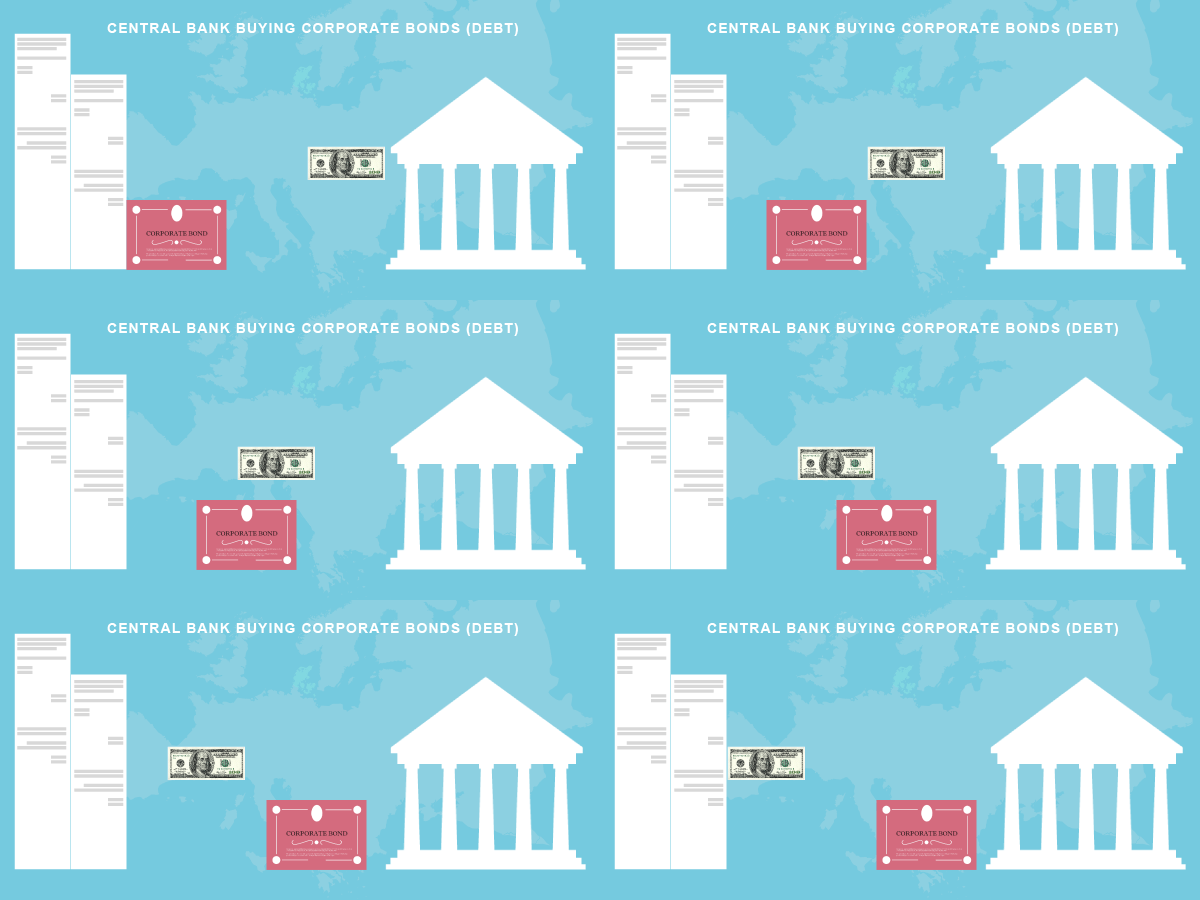
The global debt levels are rising drastically – including the European debt levels. This is of course an extension of the Covid 19 pandemic – but the pandemic did NOT cause this. It just magnified an economic problem within the EU which has been there for a long time.
If the money is handed from governments to private companies there is the corporate incentive to funnel as much money to shareholders and use a little money as possible on executing the task at hand.
A completely seperate issue are the concerns that countries in Southern Europe will use these funds to sustain their welfare benefits – especially their pension systems. According to financial researcher Bernd Raffelhüschen at the Univeristy of Freiburg, France and Italy do not only have a lower retirement age than other member countries, they also pay out higher pensions in comparison to job salaries to their citizens.
It is getting harder to justify economic suppport to irresponsible member countries, when people in the north of Europe are seeing higher taxes, reduced welfare and lower pensions – all while no necessary reforms are made in the badly run national economies.
Which leads to a fundamental question:
Where is the demand that nations in Southern Europe shows solidarity and make the necessary reforms?
The economic crisis of the pandemic is far from over. It will take several years to get society back to pre-pandemic levels.
The primary beneficiary of this money is Southern Europe; Spain, Portugal, Italy, Greece
The EU might very likely urge its rich member nations to chip in even more money in a another round of quantitative easing.
The big problem with “free money” is that is sounds good, looks good and feels good, but it never teaches people (or governments) to be responsible with money. It simply means that you risk the same problem to repeat itself all over again.
Don’t agree? Take a look at Greece.
Where the monetary policies of John Maynard Keynes (lowering interest rates and quantitative easing) have lost is power, governments and central bnaks are now looking closer at the ideas of former IMF chief Olivier Blanchard, who argues that governments can go into more debt than what has previously been advocated.
For a lack of a better word…
DEBT IS NOW GOOD
The Eu will most likekly be a big advocate for further economic stimulus in 2021 and onward.
By now Christine Lagarde (President of the European Central Bank) seems to view the ECB as a bodyguard whose duty it is to fight all enemies – foreign and domestic who may threaten the cohesion and solidarity within the EU. (such as Russia, Chinas and populists within the EU)
Despite vaccines being distributed worldwide for the next many months – and the promise of an economic recovery hangs as a big carrot in front of us all – the overall mindset in economic circles seem to be “the more debt the better”.
And that part of the EU Recovery Fund which the four member countries fought to turn into a loan? It will never be payed back anyway. The loan will be granted under very genereous terms (low interest rates – that will not counter inflation rates).
As a final point: Current mutations of the COVID-19 virus will probably prolong many lockdowns for several months – killing even more businesses.
The future increasing struggle of sustaining the European Union under higher and higher levels of debt will dwarf the issue of repaying any type of “loans”.
With this kind of mindset we risk seeing “Japanification” – national debt levels rising indefinitely – which could potentially become the new normal for EU-nations.
Such a situation would make any further economic act of “solidarity” from other member countries utterly meaningless.