ONE good reason why inflation may increase in 2024
Here is ONE good reason why US inflation may continue to rise in 2024;
Government spending.
According to Andreas Steno Larsen, former chief analyst at Nordea Bank and leading partner in Steno Research, inflation in the US might very well go up as a consequence of the government increasing its spending to compensate for rising inflation in the past year.
Every year in the US, on January 1st, COLA – the Cost-Of-Living-Adjustment raises the SSI – Social Security and Supplemental Security Income according to the past year’s inflation rate.
So, social benefits go up if the past year has experienced a rise in inflation. This is done to shield welfare recipients from rising prices on goods and services.
With the previous years of rising inflation the annual adjustment of welfare benefits creates a dangerous push for even MORE inflation in the new year, since more government spending does not decrease the amount of money in circulation but rather increases it.
In fact, if the past year has brought a rise in inflation the government should lower the amount provided through Social Security and Supplemental Income to prevent inflation rising even further in the new year.
Of course this will never happen when voters punish a government that takes away their social benefits.
But again, the voters forget that the only people to pay the bill for government spending – and rising inflation – are the voters themselves.
Government spending is the greatest driver for inflation – when the government increases the amount on welfare checks every year to compensate for the rise in inflation – due to past government spending – the government creates a vicious cycle.
The best thing the US population can do to improve the US economy in the long run, is to vote for less government spending, that they would have to cut their own welfare checks by a considerable amount.
With the latest approximately 60 billion dollar financial allocated to Ukraine-related activities in the war against Russia.
Instead Steno argues that we risk many years of higher inflation, since it is hard to get rid of rising inflation, once it has begun.
That’s why ordinary people should care very much about how big checks their government will be handing out, because the people will be paying the bill, either through taxes or through inflation.
So,
When 2025 comes around, remember to wish for a drop in inflation, or COLA – the Cost of Living Adjustment, might just raise the SSI – Social Security and Supplemental Income, yet again.
Ok, maybe my blood didn’t exactly boil. But I did get irritated reading a tweet (or is it called an “x” now?)
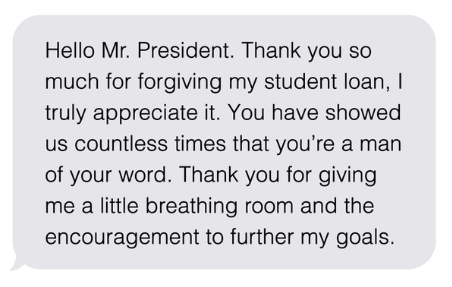
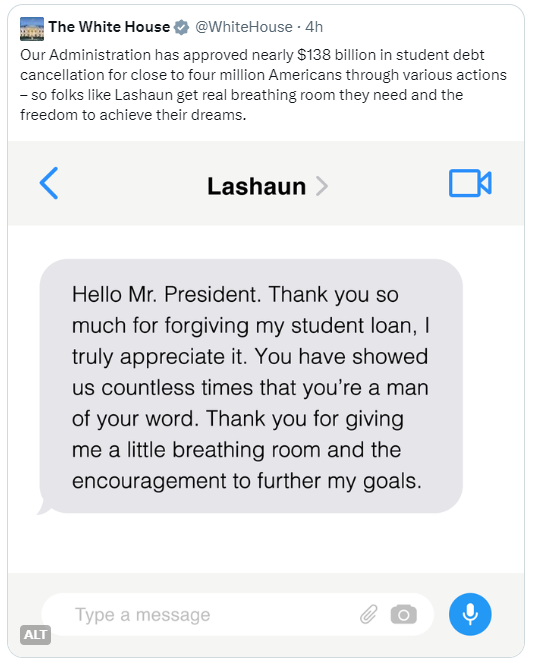
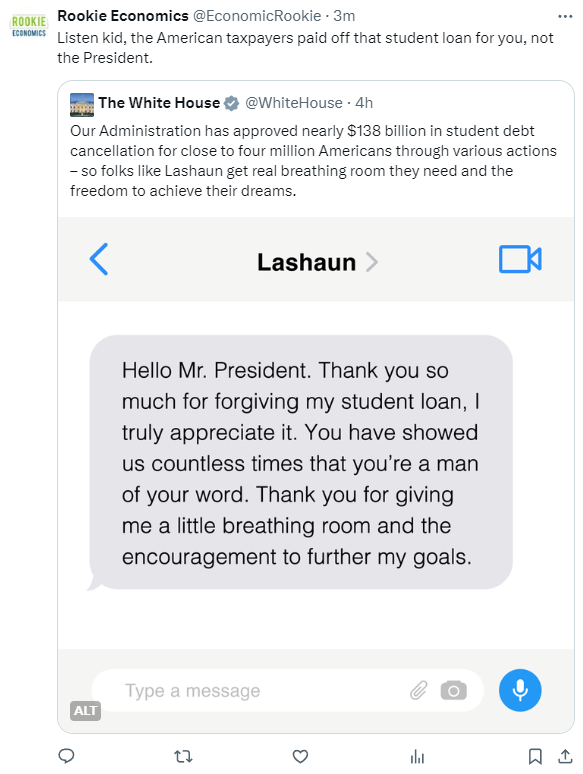
The Tweet was a deepfelt (yet misplaced) thank you from an American student to the American President Joe Biden. The reason?
The President has (apparently) singlehandedly saved said student from his/hers student debt.
Now, I am absolutely not the first person in the world to be irritated by a tweet. And to many people it might be hard to see what to be irritated about. The tweet is a sweet thank you from a student to his/her beloved President.
But what bothered me was a person giving thanks to an entity which, with regards to the monetary gesture, does not truly deserve the recognition.
The real hero in this story are the American hardworking taxpayers, who pays the bills for not only the government (and the President), but also subsidizes the campaign which paid off student loans worth 138 billion dollars.
The White House seized the opportunity and took the stage all by itself to (with no sign of humility) take credit for everything.
There are 2 elements in this little story which I find irritating. Because it shows a lack of awareness and mutual respect.
I must admit. As a worker and taxpayer myself, I disapprove when governments take credit for spending the money of a hardworking population. I also disapprove when people give the government credit, instead of crediting the people who provide the resources and make things possible.
If the nurses at the hospital save your life by giving you CPR, or the surgeon performs a bypass operation on you, would you instead thank the health department ?
I admit; It wasn’t my greatest moment, however I posted a snarky remark to the grateful (but ignorant) students along with The White House in all of its self-glorification.
Left or right, I believe that we need to applaud and cherish ordinary people’s contribution to society instead of biased and opportunistic governments.
Our society is the sum of its people. Let’s show direct appreciation and respect for each other.
I mean, the subject doesn’t radiate excitement and entertaining conversations at parties, does it?
Most people would probably label it “boring”, “opaque”, or leave it to people in suits who work at banks and in government.
But isn’t that exactly why bankers and politicians control the narrative in our society about money and finance? Ordinary people know nothing about this subject. “Because it’s boooooring!”.
As a consequence the narrative is reserved for the institutions in power.
If we want to have financial democracy in our society, we must take responsibility as ordinary citizens and educate ourselves to participate in shaping the narrative.
KNOWLEDGE IS THE KEY TO FREEDOM
I remember the years leading up to the financial crisis in 2008. I was a poor student in my mid-twenties at the time. I stood on the sideline and watched how people went amok in a You-Only-Live-Once frenzy of borrowing money to buy new kitchens, a new car, summerhouses, trips to Thailand, and of course, the ultimate key to the bursting of what was named “the housing bubble” – buying houses they couldn’t really afford, with adjustable interest rate loans.
I remember my impression of society as a floating around in a greasy pool of laziness and unimaginative self-sufficiency.
It was all very cleverly and conveniently orchestrated. Until the music suddenly stopped.
As a child my frugal parents had taught me that you shouldn’t spend more than you make, I knew it had to end sometime. And when it did, while so many people were shocked and in tears. I was relieved.
The lie that so many people had tried to pass off as a truth to each other, had been exposed as the lie it had always been.
No one could explain what had taken place – and why.
Not the politicians.
Not the bankers.
Not the media.
No one had answers.
No one took any responsibility.
As banks were collapsing while others were being saved by the government, while technically insolvent homeowners were crying in despair, I was left with three glaringly obvious conclusions at that point.
The institutions in society had failed the trust of the public, and the responsibility that came with their bestowed authority
As a result, I could no longer trust them.
I had to find the answers to my questions elsewhere.
No one can tell me how the world works anymore. They simply do not have all the pieces to the puzzle. I have to put together the pieces myself – in an endless ocean of true or false information.
But I still believe it is worth the effort – to gather a different worldview different from mainstream media.
WHAT ABOUT YOU?
Now I am asking you; Do you still have trust in the authorities, and if so, why?
BY THE WAY
Did you read my blogpost about an online group of young people who shook Wall Street at their own game?
“help improve the flow of money towards sustainable activities across the European Union.
By enabling investors to re-orient investments towards more sustainable technologies and businesses, these measures will be instrumental in making Europe climate neutral by 2050.”
The EU Commission on the core incentive of the Sustainable Finance Package
The Sustainable Finance package:
aims to clarify which economic activities support the environmental agenda of the EU through the EU Taxonomy Climate Delegated Act.
will obligate businesses to provide the public with information on sustainability through a Corporate Sustainability Reporting Directive (CSRD).
will change fiduciary acts to obligate financial firms, advisors and asset managers include sustainability in procedures and advice given to clients
Some people want to go even further and give workers and their unions influence on the way businesses conduct themselves in a future green economy. (link)
The apparent reason is to establish sustainable business management to accommodate the climate challenges now and in the future.
So, who will be paying to finance the EU’s Sustainable Finance package?
It will of course be you and me and we will primarily be paying in 3 ways:
We will be paying as customers
Companies who implement environmentally sustainable strategies will have to finance these changes through higher prices on their products.
We will be paying as investors
Not only will we be increasingly taxed on the return of our stock investments themselves, we will now also be paying through lower returns as the focus of our pension plans shifts from generating higher returns to saving the environment.
We will be paying as retirees
As hinted by the change of fiduciary acts pension funds will be advised – or actively directed by its management – to direct our pension funds into environmental sustainable projects. The question of whether it will make our pension savings grow will be a personal matter to deal with for the individual saver.
In the end this might be just one aspect of an overall pursuit of the EU to end the growth paradigm of our society as we know it.
Something happened in late January, that forced hedge fund managers at Melvin Capital to (in the words of comedian Bill Burr) “turn in their yachts” – metaphorically speaking, that is.
Apparently Michael Burry (known from the movie “The Big Short”) started the fire.
The wild ride of Gamestop’s stockprice during January, of which one of the key players in the incident himself now describes as “unnatural”, “insane”, and “dangerous”, made history and headlines worldwide as the first month of 2021 came to a close.
According to Forbes Michael Burry and his hedge fund Scion Asset Management bought 5,3 percent of Gamestop’s stock volume (ticker: GME). He then advised the board at Gamestop to utlize their buyback option on their own stocks.
Gamestop bought back about 200 million dollars worth of their own shares afterwards.
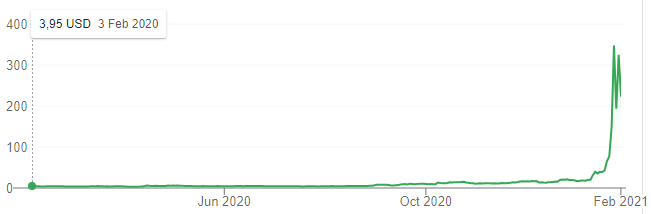
On reddit.com users in a group called WallStreetBets started paying attention to Gamestop. All the way back in July 2020 WallStreetBets user Keith Gill had promoted the stock which was at the time priced at about 4 dollars per share.
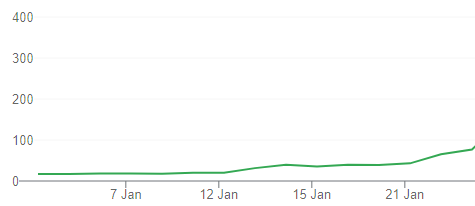
At January 12th Gamestop’s stock stumbled along at a shareprice of about 20 dollars. Then more Reddit users joined in and it slowly rose to around 40 dollars in mid-January.
By this time Wall Street had taken notice of Gamestop, but for completely different reasons.
Hedge funds such as Melvin Capital believed that the GME price was due for a downturn and began shorting the stock. The reaction from WallStreetBets was to buy more shares.
It didn’t help that online investment newsletter Citron Research, with activist short seller Andrew Left as editor, published tweets that must have motivated buyers of GME to double down.
Tomorrow am at 11:30 EST Citron will livestream the 5 reasons GameStop $GME buyers at these levels are the suckers at this poker game. Stock back to $20 fast. We understand short interest better than you and will explain. Thank you to viewers for pos feedback on last live tweet
GME made its climb towards 76 dollars a share by January 25th.
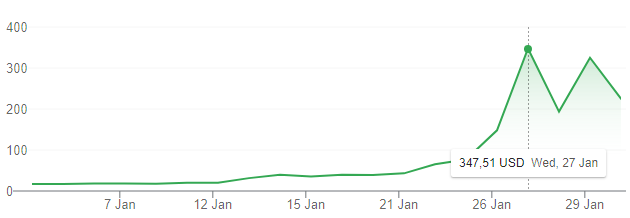
In between the 25th and the 26th the stock shot upwards to 147.98 dollars; almost a 100 percent gain – in one day!
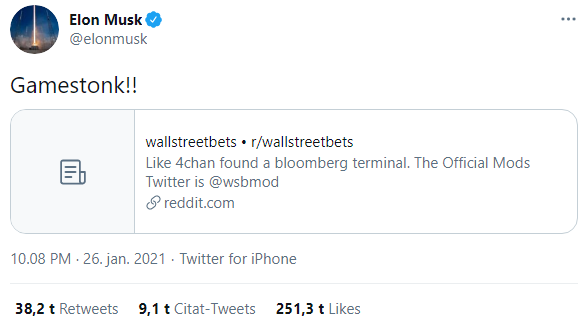
On that day Elon Musk suddenly published a tweet that read “Gamestonk!” and linked to WallStreetBets’ community page on reddit.
At this point the Gamestop stock skyrockets in price, surpassing 200, then 300 dollars and peaks at 347.51 dollars per share.
In ONE day.
According to The Wall Street Journal the New York Stock Exchange halted trading of Gamestop’s stock 9 times during its wild ride, which had primarily been spurred on through social media.
This was a historic and unprecedented move; A stock which had been at a steady price of nearly 4 dollars per share until September 2020 and then topped at 347 dollars per share only 5 months later.
Michael Burry, the investor who got in very early, also got out before the craziness started – and missed the opportunity of selling at an enormous profit. At the end of September 2020 Burry owned just 1.7 million shares og GME out of his original purchase of 3.4 million.
The sad thing is that this unprecedented spike had (almost) nothing to do with a successful and productive company or loyal investors with faith and trust in fundamentals of the viability of Gamestop.
This was the first financial battle between retail investors on social media and Wall Street.
When the podcaster joe Rogan picks up a subject, it is bound to get traction. Albeit in this case he had to get in line with practically every popular podcaster, blogger and YouTuber on a great portion of the internet.
Joe Rogan – The Gamestop Stock Situation
The reason for this media frenzy was that Gamestop’s hysterical price jump had been the subject of what is (in investing terms) called a “short squeeze”.
Hedge funds had been shorting the Gamestop stock in the expectation that it was going down in price. WallStreetBets decided to buy up Gamestop stocks to make the price go higher – squeezing the hedge funds at their own game, which was betting on the stock price to fall.
There was nothing special about this, since shorting is a common practice on Wall Street.
But maybe it shouldn’t be.
The Macbook repair teacher and YouTuber Louis Rossman explains how he got involved with the Gamestop short squeeze:
Louis Rossmann describes his own take on WallStreetBets vs. hedge funds and brokerage firms.
Louis Rossmann points out some key points:
More people have time to engage in things like the Gamestop short squeeze because of the COVID pandemic (they have been laid off or are at home during lock down)
The market information used by WallStreetBets is public information – making it possible for everyone to participate
Rossman believes that WallStreetBets turned their betting into a crusade when convential media started talking negatively about it and trading platforms blocked buying of Gamestop stocks
Conventional media blamed WallStreetBets, rather than blaming hedge funds for their practice
Customers are filing a class-action lawsuit against Robinhood for blocking trades of GME – WallStreetBets describing their actions market manipulation – “at best immoral at worst illegal”
When GME shot upwards brokers such as Robinhood, Webull, TD Ameritrade and Schwab restricted buys of GME due to “extreme volatility”. Among other restricted stocks were AMC, Koss Corp, BlackBerry Ltd and Express Ltd.
This made users on Reddit very angry and they doubled down on the GME stock, which made the price explode.
Suddenly several giant platforms stepped in to silence the retail investors.
When brokerage platforms like Robinhood restricted trades, traders went onto Google Playstore to leave their harsh reviews on the Robinhood app. Google reacted by deleting 1-star reviews of Robinhood, bringing the overall rating back up to 4 stars.
The founder of the group, 23-year-old Allen Tran, believes that they were simply first in line to be shut down, because they were on Facebook and not a free platform like Reddit.
Not even WallStreetBets dodged being silenced for a couple of hours. A Trust & Safety Team removed WallStreetBet’s server from the Discord platform for “hateful and discriminatory content after repeated warnings”.
One strategy is to shutting down servers, another is simply flipping the script.
The YouTuber and political commentator Tim Pool normally doesn’t talk about the stock market, but in this video he expresses his anger from being restricted to only selling as a small investor in Nokia.
Tim Pool got caught in the Gamestop drama: Robinhood pushed the price of Nokia shares down by blocking the ability to buy NOK.
“Nokia was down (in price). It was not being pumped. I just bought some because I liked it, and now its frozen! So what, I can only watch the price collapse, the little bit of money, I put in? I get to lose now? Is it the game you play?”
Tim Pool
Long story short of the video: Tim Pool is yet another small investor who is fed up with banks and hedge funds changing the rules and ripping ordinary people off.
On top of that he is mad at Wall Street colluding with conventional media to smear reddit users and criminalize their acts.
To many people the Gamestop short squeeze was nothing more than a stab at those people who live by the sword.
What hurt Melvin Capital and their fellow hedge funds were not only the squeeze on their short of Gamestop, they were actually shorting more stocks than the amount avilable for sale. GME was shorted close to 140 percent of its capacity.
Speaking of greed!
So, could the Gamestop short squeeze be the start of financial democracy?
For starters Tim Pool was among many ordinary investors who got pinched in the fight between WallStreetBets and greedy hedgefunds. But we also find people who have been able to benefit from this story.
GME was not the only stock being pushed on Reddit.
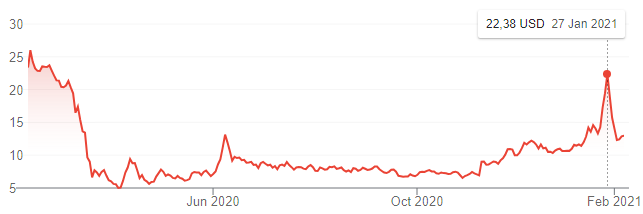
The stock had been hammered down from 23 dollars per share to an average of about 8 dollars at the beginning of the pandemic in March 2020. The stock was pushed on Reddit in January 2021 and peaked at 22.38 dollars per share on Wednesday 27th, when Ontario Teachers’ Pension Plan sold its position.
Macerich Company stock price March 2020 – February 2021
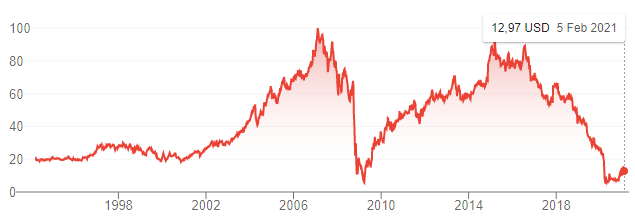
The fund had been a long time investor in Macerich. The big mall owner faced its last heavy decline in 2009 and is now back at the bottom.
Macerich stock price 1994 – 2021
Hedge funds could have destroyed Macerich Company by shorting the stock, making the stock worthless and draining Ontario Teachers’ Pension Plan of capital to finance retirement payments for their members.
Instead the pension plan were given a chance by other smalltime investors to cash out.
The Gamestop event has made some people stop and reflect.
Founder and executive editor of the online investment newsletter named Citron Research Andrew Left has announced that the company will no longer publish short-selling reports.
Citron Research origninally started out as a voice against the establishment. With the latest Gamestop frenzy Andrew Left drew the conclusion that they had become a voice of the establishment.
The decision may partly be due to the negative action taken against him and his family during the short squeeze. His personal information has been published, his social media accounts have been hacked and threatening messages have been sent to his wife and children.
Still, at least one hedge fund portfolio manager agrees with the users on Reddit. Nate Koppikar works for the hedge fund Orso Partners. He analyses companies to find hidden indicators that their stocks are likely to fall, if these indicators are made public. In short, he’s among the people who short stocks.
Koppikar followed the discussions on WallStreetBets on Reddit. When he realized that the hedge fund Melvin Capital would be hit by the short squeeze on Gamestop, he went through the holdings of Orso Partners to see if they had anything on their books which overlapped with Melvin Capital’s investments.
As Koppikar points out the potential losses a short seller might face are infinite. This made the rising price in Gamestop extremely dangerous to any short seller who had a relation to the stock.
Orso Partners did not have counter party risk towards Melvin Capital, but Koppikar still worried about the risk of financial entanglement with other any hedge fund, who might be connected with Melvin Capital through their investments – posing an indirect risk to Orso partners.
The whole situation must have felt like a deja vu – a flashback from the crash of Lehman Brothers in 2008.
In the end Melvin Capital was bailed out by the hedge funds Point72 and Citadel.
Koppikar was nonetheless worried when the chairman of The Federal Reserve, Jerome Powell downplayed the chaos in the markets. He found it scary because he did not think Powell took the situation serious. Perhaps because The Federal Reserve did not understand the problem to its full extent.
There are several reasons why Koppikar agrees with Reddit users.
He believes that hedge funds create no jobs or value while, in turn, creating uneven conditions on the capital markets along with increasing wealth inequality.
As a consequence he believes they should be heavily regulated.
Regardless of the events many people have now turned their attention to the stock market – and the ways hedge funds make money.
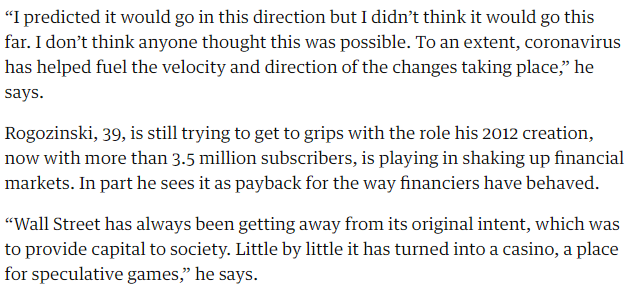
At this point even the founder of WallStreetBets is surprised. As he states in an interview with the Guardian:
Founder of WallStreetBets, Jaime Rogozinski expresses his surprise on their success. (Source: theguardian.com)
What does this say about the stock market? And what will happen once more and more ordinary people take an interest into how stocks are traded and manipulated by the big players?
Another YouTuber, Eli the Computer Guy, asks a very good question:
What happens when the next generation doesn’t play the game the way the previous generation did?
We are in late January 2021. Needless to say that the hopes are high after the strenous year of 2020.
In Denmark the government has prolonged the December lockdowns of retail stores, schools, hair salons, massage parlors etc – right at the height of christmas shopping.
The businesses which are able to survive can hope for the lockdown to end early February. Which is very doubtful.
Vaccines are arriving but it does not hide the fact that especially the first two quarters of 2021 will be a slow crawl towards the light.
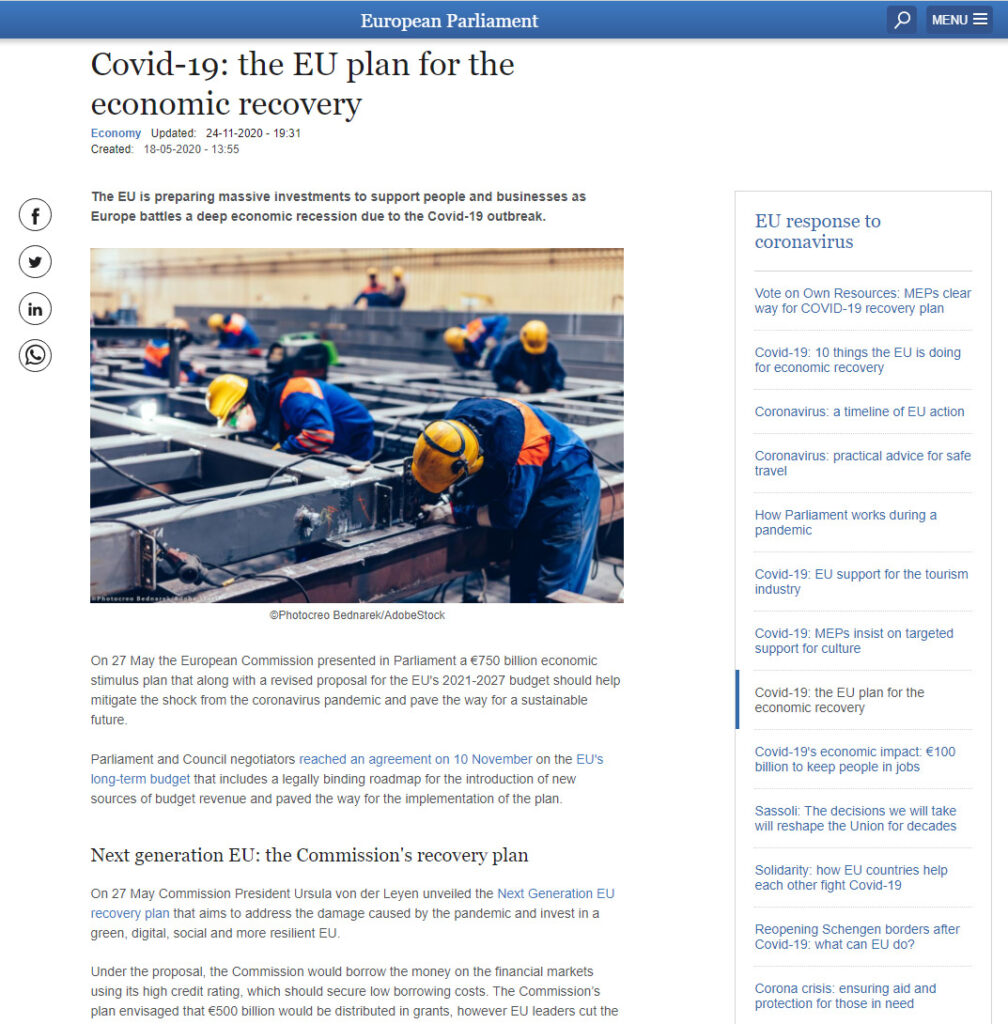
As an economic response to the Corona pandemic the EU Commision has obligateded all member countries to chip in for a “solidaric” recovery fund of 750 billion Euro.
The EU initiated a 750 billion recovery plan in 2020
The overall purpose of the recovery fund can be divided into 4 areas:
Create growth
Create jobs
Spur on “green” change
Increase digitization
By critics this can be seen as either a form of bribe to certain member countries that are questioning their memebership of the EU, or, it can be seen as sincere help from rich member countries to struggling fellow members.
No matter what it will be a direct economic stimulance (quantitative easing) of the European economy.
However, 750 billion Euro will not be enough. More on that later.
The EU Recovery Fund was originally thought to be free money – a grant to struggling member countries with no strings attached.
However, a coalition of member countries (Holland, Sweden, Austria and Denmark) insisted that at least part of the fund be given as loans instead of free money.
As a result 390 billion is to be free money, the rest (360 billion Euro) is to be accessed as a loan, which the EU member countries can take on, if they choose to do so.
70% of the funds capital is to be distributed through 2021-2022. The last 30% will be handed out before the end of 2023.
Every member country takes on a burden of extra debt, the winning argument is the advantage of very low interest rates.
Here is how the EU imagines the process:
According to Startup Europe most of the funds will go to Southern Europe (Greece, Italy, Spain and Portugal) to prevent a potential recession of EU-historic proportions.
The national governments will be managing and distributing the funds to the worthy recipients.
Greece will primarily need funds for the small entrepreneurs who need capital in their early stages of development.
Italy, in turn, is plagued by slow digitization and the inability to grow small businesses.
While Italy is seeking to digitize its infrastructure Spain needs to educate its population in digital skills.
BUT (as stated earlier) at this point 750 billion Euro isn’t going to be enough.
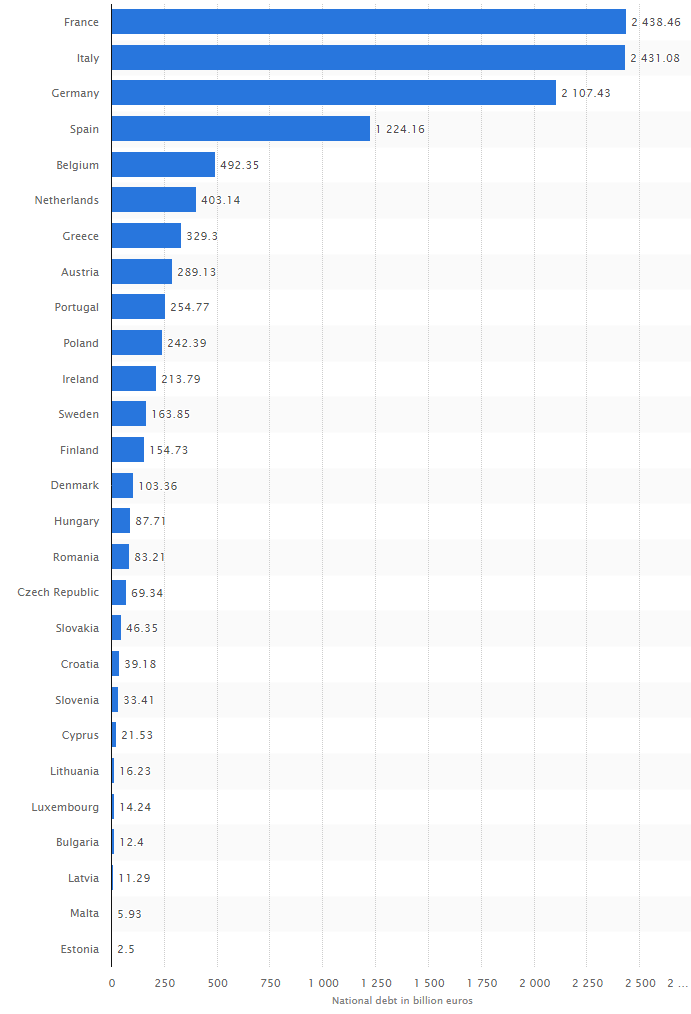
First, there’s the public debt. Even before the COVID-19 pandemic the national debt measured in Euro was already substantial in several major EU countries.
National debt in EU member states (in billion Euro) – 1st quarter 2020 | Source: statista.com (fig. 1)
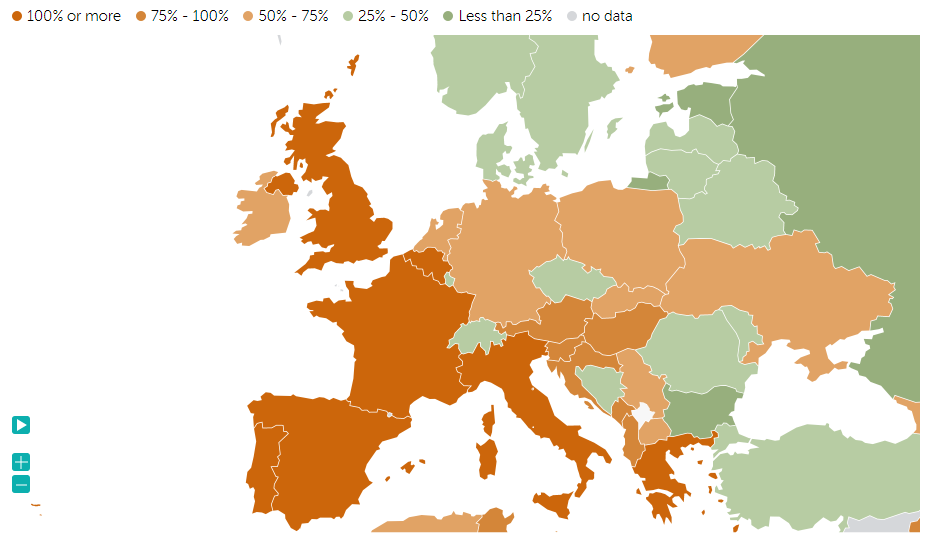
Looking at the Government debt to GDP ratios puts many major EU member countries in the red: United Kingdom, Belgium, France, Spain, Portugal, Italy and Greece.
IMF – General government debt to GDP (fig. 2)
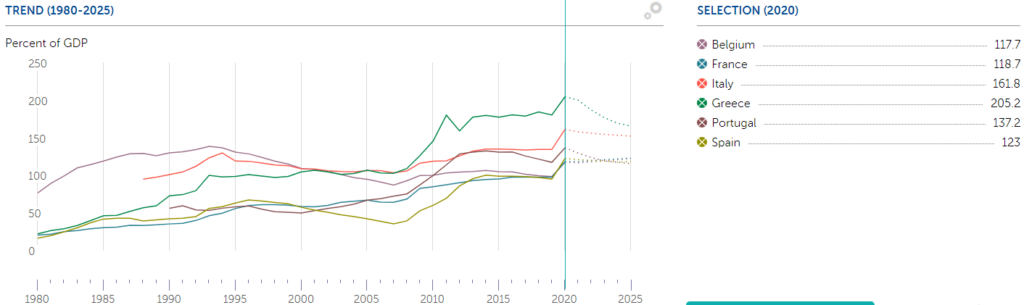
Below (fig. 3) is the IMF debt prognosis for these EU countries:
It is pretty safe to assume that the IMF debt prognosis onward from 2020 (fig. 3) of falling debt for Germany, Belgium, UK, France, Spain, Portugal, Italy and Greece will not hold. Debt will rise in 2021 in every part of the EU.
This creates another problem.
Studies have proven that there are limits to how high government debt can be before it begins to increasingly inhibit economic growth.
The debt-to-GDP percentage is an indicator of a nations ability to repay its debt. The ratio is calculated like this: (DEBT/ GDP * 100)
The public debt of France varies depending on which sources delivers the numbers.
Maximum debt-to-GDP ratio for developed countries is 60 percent.
Maximum debt-to-GDP ratio for developing countries is 40 percent
The World Bank:
Maximum debt-to-GDP ratio for developed countries is 64 percent
Maximum debt-to-GDP ratio for developing countries is 40 percent.
The World Bank furthermore warns that countries with prologned periods of debt-to-GDP over 77 percent will experience significantly lower growth.
In all cases it goes that the higher the debt percentage to GDP the harder it will be to pay off the debt.
If the debt-to-GDP ratio exceeds 90 percent it inhibits growth notably for both developed and developing countries.
An important factor is the debt trajectory which signals whether government debt will be higher or lower in the years to come.
Secondly, there’s the private debt
Private businesses are hemmorrhaging liquidity and cashflow during the pandemic lockdowns. Many have taken on corporate debt due to the low interest rates.
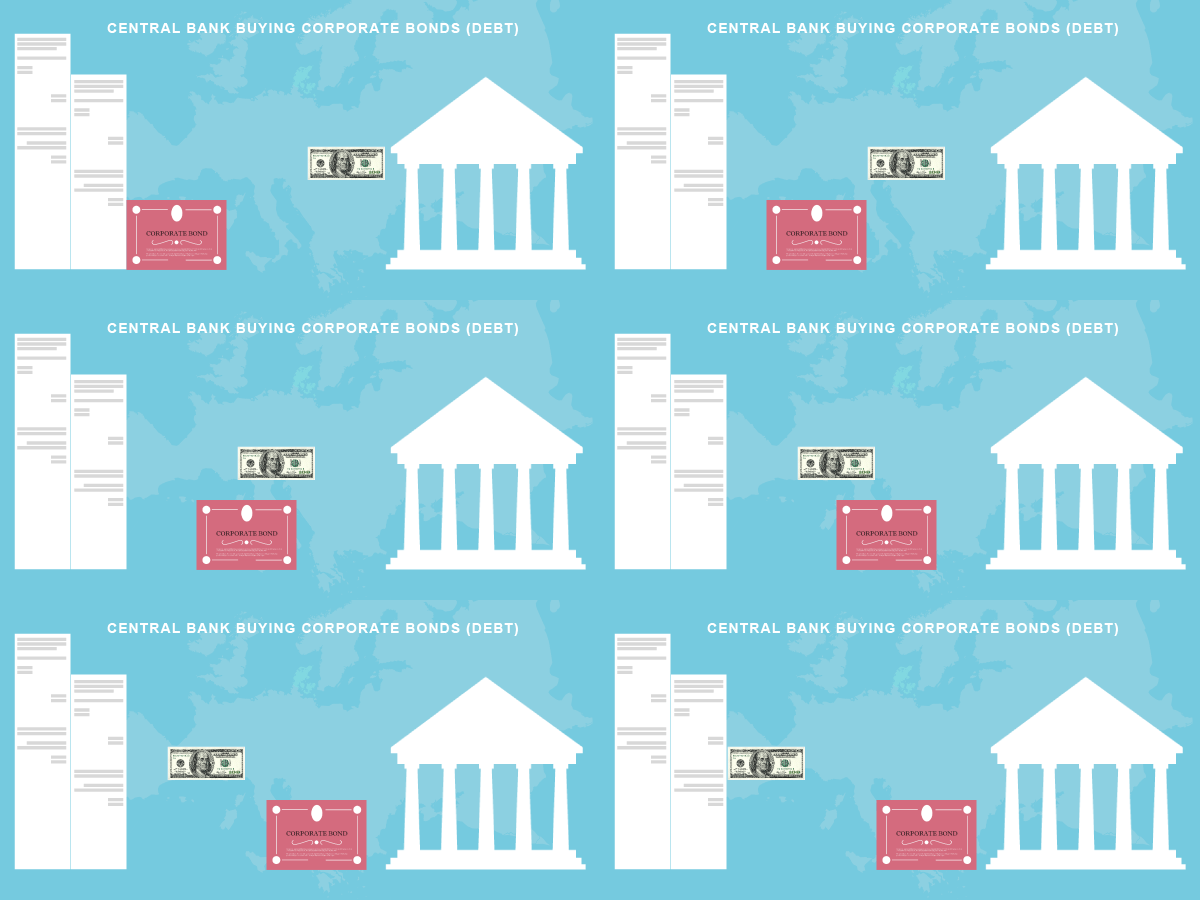
If the private debt becomes too great it risks turning into public debt through defaulting loans under state guarantees and central banks buying up bad debt in the form of corporate bonds.
Central bank(right) buying debt in the form of corporate bonds
The global debt levels are rising drastically – including the European debt levels. This is of course an extension of the Covid 19 pandemic – but the pandemic did NOT cause this. It just magnified an economic problem within the EU which has been there for a long time.
If the money is handed from governments to private companies there is the corporate incentive to funnel as much money to shareholders and use a little money as possible on executing the task at hand.
A completely seperate issue are the concerns that countries in Southern Europe will use these funds to sustain their welfare benefits – especially their pension systems. According to financial researcher Bernd Raffelhüschen at the Univeristy of Freiburg, France and Italy do not only have a lower retirement age than other member countries, they also pay out higher pensions in comparison to job salaries to their citizens.
It is getting harder to justify economic suppport to irresponsible member countries, when people in the north of Europe are seeing higher taxes, reduced welfare and lower pensions – all while no necessary reforms are made in the badly run national economies.
Which leads to a fundamental question:
Where is the demand that nations in Southern Europe shows solidarity and make the necessary reforms?
The economic crisis of the pandemic is far from over. It will take several years to get society back to pre-pandemic levels.
The primary beneficiary of this money is Southern Europe; Spain, Portugal, Italy, Greece
The EU might very likely urge its rich member nations to chip in even more money in a another round of quantitative easing.
The big problem with “free money” is that is sounds good, looks good and feels good, but it never teaches people (or governments) to be responsible with money. It simply means that you risk the same problem to repeat itself all over again.
Don’t agree? Take a look at Greece.
Where the monetary policies of John Maynard Keynes (lowering interest rates and quantitative easing) have lost is power, governments and central bnaks are now looking closer at the ideas of former IMF chief Olivier Blanchard, who argues that governments can go into more debt than what has previously been advocated.
For a lack of a better word…
DEBT IS NOW GOOD
The Eu will most likekly be a big advocate for further economic stimulus in 2021 and onward.
By now Christine Lagarde (President of the European Central Bank) seems to view the ECB as a bodyguard whose duty it is to fight all enemies – foreign and domestic who may threaten the cohesion and solidarity within the EU. (such as Russia, Chinas and populists within the EU)
Despite vaccines being distributed worldwide for the next many months – and the promise of an economic recovery hangs as a big carrot in front of us all – the overall mindset in economic circles seem to be “the more debt the better”.
And that part of the EU Recovery Fund which the four member countries fought to turn into a loan? It will never be payed back anyway. The loan will be granted under very genereous terms (low interest rates – that will not counter inflation rates).
As a final point: Current mutations of the COVID-19 virus will probably prolong many lockdowns for several months – killing even more businesses.
The future increasing struggle of sustaining the European Union under higher and higher levels of debt will dwarf the issue of repaying any type of “loans”.
With this kind of mindset we risk seeing “Japanification” – national debt levels rising indefinitely – which could potentially become the new normal for EU-nations.
Such a situation would make any further economic act of “solidarity” from other member countries utterly meaningless.