Something happened in late January, that forced hedge fund managers at Melvin Capital to (in the words of comedian Bill Burr) “turn in their yachts” – metaphorically speaking, that is.
Apparently Michael Burry (known from the movie “The Big Short”) started the fire.
The wild ride of Gamestop’s stockprice during January, of which one of the key players in the incident himself now describes as “unnatural”, “insane”, and “dangerous”, made history and headlines worldwide as the first month of 2021 came to a close.
According to Forbes Michael Burry and his hedge fund Scion Asset Management bought 5,3 percent of Gamestop’s stock volume (ticker: GME). He then advised the board at Gamestop to utlize their buyback option on their own stocks.
Gamestop bought back about 200 million dollars worth of their own shares afterwards.
On reddit.com users in a group called WallStreetBets started paying attention to Gamestop. All the way back in July 2020 WallStreetBets user Keith Gill had promoted the stock which was at the time priced at about 4 dollars per share.
At January 12th Gamestop’s stock stumbled along at a shareprice of about 20 dollars. Then more Reddit users joined in and it slowly rose to around 40 dollars in mid-January.
By this time Wall Street had taken notice of Gamestop, but for completely different reasons.
Hedge funds such as Melvin Capital believed that the GME price was due for a downturn and began shorting the stock. The reaction from WallStreetBets was to buy more shares.
It didn’t help that online investment newsletter Citron Research, with activist short seller Andrew Left as editor, published tweets that must have motivated buyers of GME to double down.
GME made its climb towards 76 dollars a share by January 25th.
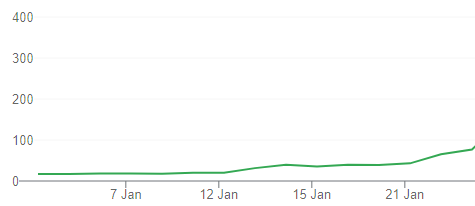
In between the 25th and the 26th the stock shot upwards to 147.98 dollars; almost a 100 percent gain – in one day!
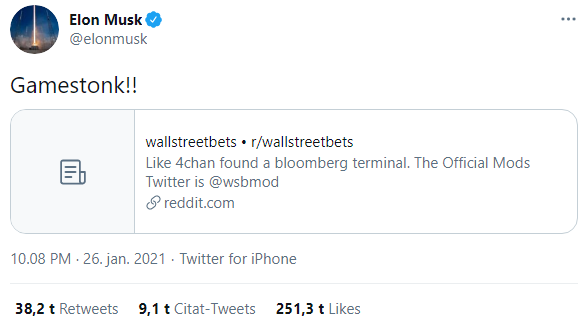
On that day Elon Musk suddenly published a tweet that read “Gamestonk!” and linked to WallStreetBets’ community page on reddit.
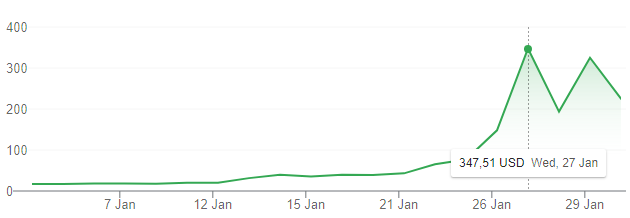
At this point the Gamestop stock skyrockets in price, surpassing 200, then 300 dollars and peaks at 347.51 dollars per share.
In ONE day.
According to The Wall Street Journal the New York Stock Exchange halted trading of Gamestop’s stock 9 times during its wild ride, which had primarily been spurred on through social media.
This was a historic and unprecedented move; A stock which had been at a steady price of nearly 4 dollars per share until September 2020 and then topped at 347 dollars per share only 5 months later.
Michael Burry, the investor who got in very early, also got out before the craziness started – and missed the opportunity of selling at an enormous profit. At the end of September 2020 Burry owned just 1.7 million shares og GME out of his original purchase of 3.4 million.
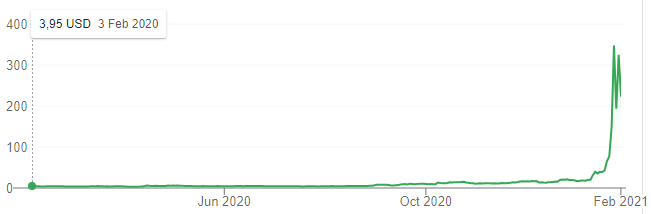
The sad thing is that this unprecedented spike had (almost) nothing to do with a successful and productive company or loyal investors with faith and trust in fundamentals of the viability of Gamestop.
This was the first financial battle between retail investors on social media and Wall Street.
When the podcaster joe Rogan picks up a subject, it is bound to get traction. Albeit in this case he had to get in line with practically every popular podcaster, blogger and YouTuber on a great portion of the internet.
The reason for this media frenzy was that Gamestop’s hysterical price jump had been the subject of what is (in investing terms) called a “short squeeze”.
Hedge funds had been shorting the Gamestop stock in the expectation that it was going down in price. WallStreetBets decided to buy up Gamestop stocks to make the price go higher – squeezing the hedge funds at their own game, which was betting on the stock price to fall.
There was nothing special about this, since shorting is a common practice on Wall Street.
But maybe it shouldn’t be.
The Macbook repair teacher and YouTuber Louis Rossman explains how he got involved with the Gamestop short squeeze:
Louis Rossmann points out some key points:
- More people have time to engage in things like the Gamestop short squeeze because of the COVID pandemic (they have been laid off or are at home during lock down)
- The market information used by WallStreetBets is public information – making it possible for everyone to participate
- Rossman believes that WallStreetBets turned their betting into a crusade when convential media started talking negatively about it and trading platforms blocked buying of Gamestop stocks
- Conventional media blamed WallStreetBets, rather than blaming hedge funds for their practice
- Customers are filing a class-action lawsuit against Robinhood for blocking trades of GME – WallStreetBets describing their actions market manipulation – “at best immoral at worst illegal”
When GME shot upwards brokers such as Robinhood, Webull, TD Ameritrade and Schwab restricted buys of GME due to “extreme volatility”. Among other restricted stocks were AMC, Koss Corp, BlackBerry Ltd and Express Ltd.
This made users on Reddit very angry and they doubled down on the GME stock, which made the price explode.
Suddenly several giant platforms stepped in to silence the retail investors.
When brokerage platforms like Robinhood restricted trades, traders went onto Google Playstore to leave their harsh reviews on the Robinhood app. Google reacted by deleting 1-star reviews of Robinhood, bringing the overall rating back up to 4 stars.
Facebook banned the group “Robinhood Stock Traders” with 157,000 members due to violation of Facebook policies on “adult sexual exploitation”.
The founder of the group, 23-year-old Allen Tran, believes that they were simply first in line to be shut down, because they were on Facebook and not a free platform like Reddit.
Then, after heavy media attention, Facebook reversed its course.
Not even WallStreetBets dodged being silenced for a couple of hours. A Trust & Safety Team removed WallStreetBet’s server from the Discord platform for “hateful and discriminatory content after repeated warnings”.
One strategy is to shutting down servers, another is simply flipping the script.
On established media such as Forbes and Washington Post articles soon appeared, telling readers that shortsellers were the true heroes and that the “populist Gamestop hype” should just be ignored.
But then there is social media.
The YouTuber and political commentator Tim Pool normally doesn’t talk about the stock market, but in this video he expresses his anger from being restricted to only selling as a small investor in Nokia.
“Nokia was down (in price). It was not being pumped. I just bought some because I liked it, and now its frozen! So what, I can only watch the price collapse, the little bit of money, I put in? I get to lose now? Is it the game you play?”
Tim Pool
Long story short of the video: Tim Pool is yet another small investor who is fed up with banks and hedge funds changing the rules and ripping ordinary people off.
On top of that he is mad at Wall Street colluding with conventional media to smear reddit users and criminalize their acts.
To many people the Gamestop short squeeze was nothing more than a stab at those people who live by the sword.
What hurt Melvin Capital and their fellow hedge funds were not only the squeeze on their short of Gamestop, they were actually shorting more stocks than the amount avilable for sale. GME was shorted close to 140 percent of its capacity.
Speaking of greed!
So, could the Gamestop short squeeze be the start of financial democracy?
For starters Tim Pool was among many ordinary investors who got pinched in the fight between WallStreetBets and greedy hedgefunds. But we also find people who have been able to benefit from this story.
GME was not the only stock being pushed on Reddit.
Ontario Teachers’ Pension Plan took out almost 500 million dollars when they sold their stake of 24.56 million shares in the real estate investment trust Macerich Company.
The stock had been hammered down from 23 dollars per share to an average of about 8 dollars at the beginning of the pandemic in March 2020. The stock was pushed on Reddit in January 2021 and peaked at 22.38 dollars per share on Wednesday 27th, when Ontario Teachers’ Pension Plan sold its position.
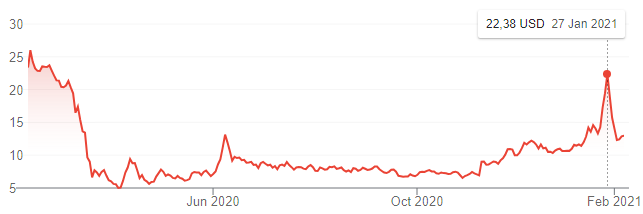
The fund had been a long time investor in Macerich. The big mall owner faced its last heavy decline in 2009 and is now back at the bottom.
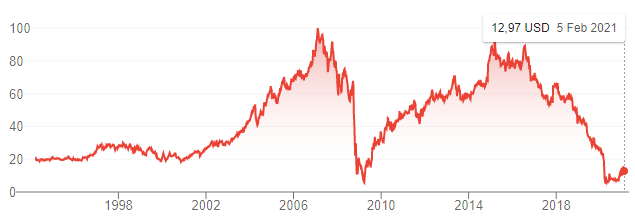
Hedge funds could have destroyed Macerich Company by shorting the stock, making the stock worthless and draining Ontario Teachers’ Pension Plan of capital to finance retirement payments for their members.
Instead the pension plan were given a chance by other smalltime investors to cash out.
The Gamestop event has made some people stop and reflect.
Founder and executive editor of the online investment newsletter named Citron Research Andrew Left has announced that the company will no longer publish short-selling reports.
Citron Research origninally started out as a voice against the establishment. With the latest Gamestop frenzy Andrew Left drew the conclusion that they had become a voice of the establishment.
The decision may partly be due to the negative action taken against him and his family during the short squeeze. His personal information has been published, his social media accounts have been hacked and threatening messages have been sent to his wife and children.
Still, at least one hedge fund portfolio manager agrees with the users on Reddit. Nate Koppikar works for the hedge fund Orso Partners. He analyses companies to find hidden indicators that their stocks are likely to fall, if these indicators are made public. In short, he’s among the people who short stocks.
Koppikar followed the discussions on WallStreetBets on Reddit. When he realized that the hedge fund Melvin Capital would be hit by the short squeeze on Gamestop, he went through the holdings of Orso Partners to see if they had anything on their books which overlapped with Melvin Capital’s investments.
As Koppikar points out the potential losses a short seller might face are infinite. This made the rising price in Gamestop extremely dangerous to any short seller who had a relation to the stock.
Orso Partners did not have counter party risk towards Melvin Capital, but Koppikar still worried about the risk of financial entanglement with other any hedge fund, who might be connected with Melvin Capital through their investments – posing an indirect risk to Orso partners.
The whole situation must have felt like a deja vu – a flashback from the crash of Lehman Brothers in 2008.
In the end Melvin Capital was bailed out by the hedge funds Point72 and Citadel.
Koppikar was nonetheless worried when the chairman of The Federal Reserve, Jerome Powell downplayed the chaos in the markets. He found it scary because he did not think Powell took the situation serious. Perhaps because The Federal Reserve did not understand the problem to its full extent.
There are several reasons why Koppikar agrees with Reddit users.
He believes that hedge funds create no jobs or value while, in turn, creating uneven conditions on the capital markets along with increasing wealth inequality.
As a consequence he believes they should be heavily regulated.
Regardless of the events many people have now turned their attention to the stock market – and the ways hedge funds make money.
At this point even the founder of WallStreetBets is surprised. As he states in an interview with the Guardian:
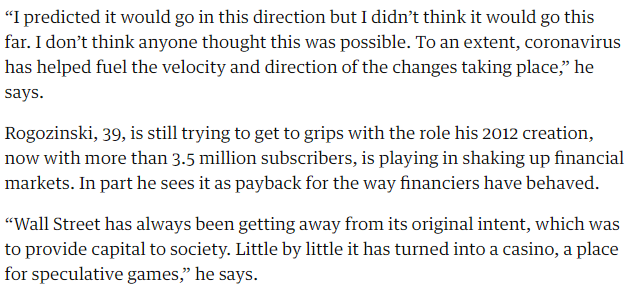
What does this say about the stock market? And what will happen once more and more ordinary people take an interest into how stocks are traded and manipulated by the big players?
Another YouTuber, Eli the Computer Guy, asks a very good question:
What happens when the next generation doesn’t play the game the way the previous generation did?